What is a muscle-sparing hip replacement?
Muscle and tissue surround and support the hip joint. During hip replacement, your doctor has to get past that muscle and soft tissue to access the bones of the joint – either from the side, the back, or the front of your body. There are hip replacement techniques with smaller incisions, designed to minimize the impact on those tissues and muscles.1,2
These kinds of surgeries are often referred to as muscle sparing or minimally invasive. Take a look at how these two muscle-sparing approaches to surgery compare to each other, and to standard surgery. Then, talk to your doctor to see if any of these approaches are right for you.
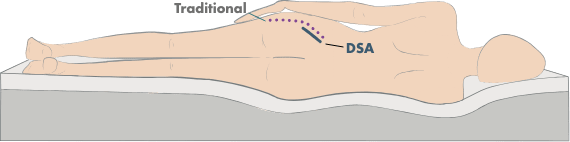
Direct Superior Approach
A smaller incision at the upper side of the hip helps the surgeon avoid cutting (and then reattaching) the key muscle group that enables you to walk and bend.1 That muscle group includes the IT band (or Iliotibial band) and the external rotators that connect your pelvis to your knee1. Avoiding injury to that group of muscles and ligaments may potentially mean better hip stability and recovery1,3,4.
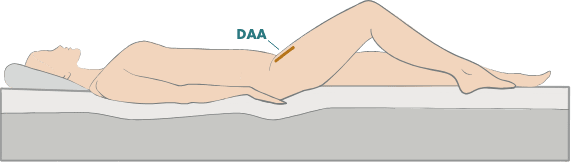
Direct Anterior Approach
A smaller incision at the front of the hip leaves all of the muscle intact.5 The doctor pushes the soft tissue aside to access the hip joint and perform the joint replacement, rather than detaching any tendons or muscle.5 This has the potential to make a big difference both during surgery and in recovery.2
Compare surgeries:
Below are some general considerations and potential benefits of hip replacement surgery using the traditional, direct superior and direct anterior approaches. However, individual results may vary and not all patients will have the same outcomes and experiences.
Traditional
Surgical considerations
10-12 inch incision8
Incision along the side or along the back of the hip
Disturbs muscle and tendons
Longer scar
Typical precautions
Take your time to recover
Avoid crossing your legs. Avoid bending your hip more than 90 degrees. Avoid turning your feet too far in or out. Sleep with a pillow between your legs.
Direct Superior Approach
Surgical considerations
3-6 inch incision1
Incision higher at side of the hip
Avoid cutting IT band1
Potential benefits
Minimizes impact on muscle and tendons1
Smaller scar
Walk on the same day of surgery under your doctor’s supervision
Enhanced hip stability and recovery after surgery1,3,4
Direct Anterior Approach
Surgical considerations
3-4 inch incision5
Incision at the front of the hip
Potential benefits
Minimizes soft tissue impact resulting in positive functional outcomes6,7
Smaller scar
Walk on the same day of surgery under your doctor’s supervision
No hip-dislocation movement precautions after surgery6
Find out if joint replacement is right for you.
References:
- Roger DJ, Hill D. Minimally Invasive Total Hip Arthroplasty Technique. Clin Orthop Relat Res (2012) 470:2227-34 ((URL to abstract: https://doi.org/10.1007/s11999-011-2225-z))
- Post ZD, Orozco F, Diaz-Ledezma C, Hozack WJ, Ong A. Direct anterior approach for total hip arthroplasty: Indications, techniques, and results. JAAOS. 2014;11(9):595-603.
- Khan RJ, Fick D, Khoo P, Yao F, Nivbrant B, Wood D. Less invasive total hip arthroplasty: Description of a new technique. J Arthroplasty. 2006;21:1038-1046.
- Penenberg BL, Bolling WS, Riley M. Percutaneously assisted total hip arthroplasty (PATH): a preliminary report. J Bone Joint Surg Am. 2008;90(suppl 4):209–220.
- Wenz J, Gurkan I, Jibodh S. Mini-incision total hip arthroplasty: A comparative assessment of perioperative outcomes. Orthopedics. 2002;25(10):1031-43.
- Amanatullah DF, Schraga D. Minimally Invasive Total Hip Arthroplasty Technique. Medscape, 9 May 2023. emedicine.medscape.com/article/2000333-technique#c1
- Restrepo C, Parvizi J, Pour AE, Hozack WJ. Prospective randomized study of two surgical approaches for total hip arthroplasty. J Arthroplasty. 2010;25(5):671-679.
- American Academy of Orthopaedic Surgeons. Treatment: Minimally Invasive Total Hip Replacement. https://orthoinfo.aaos.org/en/treatment/minimally-invasive-total-hip- replacement/. Accessed 9 May 2023.
U.S. Modular Hip Settlement Program
Stryker's Voluntary Recall of Rejuvenate and ABG II Modular-Neck Hip Stems
Hip Replacements
Hip joint replacement is intended for use in individuals with joint disease resulting from degenerative and rheumatoid arthritis, avascular necrosis, fracture of the neck of the femur or functional deformity of the hip.
Joint replacement surgery is not appropriate for patients with certain types of infections, any mental or neuromuscular disorder which would create an unacceptable risk of prosthesis instability, prosthesis fixation failure or complications in postoperative care, compromised bone stock, skeletal immaturity, severe instability of the joint, or excessive body weight.
Like any surgery, joint replacement surgery has serious risks which include, but are not limited to, pain, infection, bone fracture, change in the treated leg length (hip), joint stiffness, hip joint fusion, amputation, peripheral neuropathies (nerve damage), circulatory compromise (including deep vein thrombosis (blood clots in the legs)), genitourinary disorders (including kidney failure), gastrointestinal disorders (including paralytic ileus (loss of intestinal digestive movement)), vascular disorders (including thrombus (blood clots), blood loss, or changes in blood pressure or heart rhythm), bronchopulmonary disorders (including emboli, stroke or pneumonia), heart attack, and death.
Implant related risks which may lead to a revision of the implant include dislocation, loosening, fracture, nerve damage, heterotopic bone formation (abnormal bone growth in tissue), wear of the implant, metal and/or foreign body sensitivity, soft tissue imbalance, osteolysis (localized progressive bone loss), audible sounds during motion, and reaction to particle debris. Hip implants may not provide the same feel or performance characteristics experienced with a normal healthy joint.
The information presented is for educational purposes only. Speak to your doctor to decide if joint replacement surgery is appropriate for you. Individual results vary and not all patients will return to the same activity level. The lifetime of any joint replacement is limited and depends on several factors like patient weight and activity level. Your doctor will counsel you about strategies to potentially prolong the lifetime of the device, including avoiding high-impact activities, such as running, as well as maintaining a healthy weight. It is important to closely follow your doctor’s instructions regarding post-surgery activity, treatment and follow-up care. Ask your doctor if a joint replacement is right for you.
Stryker Corporation or its other divisions or other corporate affiliated entities own, use or have applied for the following trademarks or service marks: Mako, Mobile Bearing Hip, Stryker, Together with our customers, we are driven to make healthcare better. All other trademarks are trademarks of their respective owners or holders.
JR-OTH-WEB-560450